
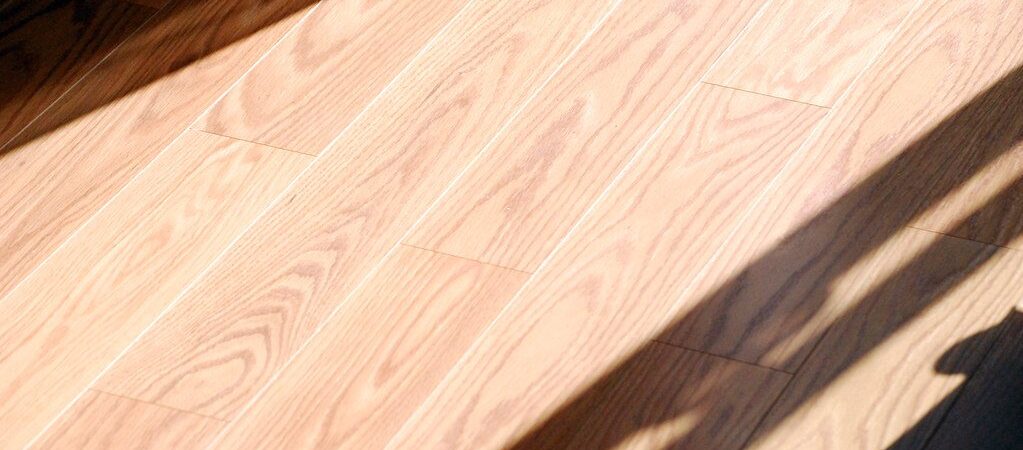
Sunlight is one of the great luxuries of a well-designed home. Floor-to-ceiling windows in a Winnetka living room, a wall of south-facing glass in a new construction build in Hinsdale, a sunroom that glows all afternoon in Barrington. That same light, though, is quietly at work on your floors. Over months and years, ultraviolet light changes the color of wood and its finish, and if part of the floor is shaded by a rug or a sofa while the rest bathes in sun, you eventually get a line where there shouldn’t be one.
The good news: this is entirely manageable, provided you plan for it from the start rather than discovering it the day you finally move the console table.
Why Wood Floors Change Color in the First Place
Two things happen at once. The finish on top can amber, yellow or subtly shift tone with UV exposure, and the wood itself photo-oxidizes, changing color independently of anything applied over it. That second process is natural, permanent and, in many species, quite beautiful. It is not damage. It is the floor maturing.
What matters is whether it happens evenly. A floor that mellows uniformly across an entire great room reads as rich and lived-in. A floor that mellows everywhere except the rectangle under an area rug reads as a mistake.
Not All Species Behave the Same Way
Species selection is the single biggest lever you have, and it’s worth thinking about before installation rather than after.
- American cherry and Brazilian cherry change dramatically, deepening from light to a rich red-brown within months. Stunning, but unforgiving of shaded patches.
- Red oak warms noticeably, pushing further toward its natural pink-red undertone over time.
- White oak is comparatively stable, which is a large part of why it dominates luxury interiors right now. It shifts, but slowly and gracefully. You can read more about the differences in our guide to solid hardwood options.
- Maple and hickory tend to amber modestly.
- Walnut moves in the opposite direction from most species, lightening and softening rather than darkening.
If your home has serious sun exposure and you want the floor to look the same in year five as it does in year one, white oak with a modern finish is usually the most predictable path.
Finish Choices That Slow the Process
Modern waterborne finishes are far less prone to yellowing than the oil-based polyurethanes of a generation ago, and many quality products now include UV inhibitors. They won’t stop wood from aging, but they meaningfully reduce the finish’s own contribution to color shift.
Sheen plays a role too. Higher-gloss surfaces reflect more light away, while matte and satin absorb and scatter it. Matte and satin also do a better job of hiding the subtle unevenness that develops over years, which is one more reason they’ve become the default in high-end Chicagoland homes. Our overview of flooring types walks through how finish and species work together.
Engineered flooring deserves a mention here as well. Its wear layer is real wood, so it ages exactly like solid hardwood does. The dimensional stability advantage of engineered construction is about moisture, not light. Luxury vinyl plank, by contrast, is printed and UV-coated, and while quality LVP is highly fade-resistant, budget products in a sun-drenched room can wash out in ways that cannot be corrected.
Practical Habits That Make a Real Difference
None of this requires living in a dark house. A few small habits handle most of it:
- Rotate area rugs and move furniture periodically. Twice a year is plenty. Shifting a rug even a foot or two allows the covered wood to catch up with its surroundings.
- Use UV-filtering window film on the worst-exposed elevations. It’s nearly invisible and blocks the large majority of ultraviolet light.
- Let sheers, shades or drapes do some work during peak afternoon hours in the rooms that take the most direct sun.
- Choose breathable rug pads rather than solid rubber-backed mats, which can trap moisture and mark the finish.
- Be patient with new floors. Most of the color change happens in the first six to twelve months. Leaving a large rug down through that entire window is what creates the sharpest lines.
What to Do If the Lines Have Already Appeared
If you’ve inherited a floor with visible shadow lines, start by simply removing the rug or furniture and giving it a few months. Wood is often more forgiving than homeowners expect, and mild differences frequently even out on their own once the whole surface sees the same light.
When the contrast is severe, sanding and refinishing removes the aged surface layer and resets the floor to a uniform starting point. It’s a bigger undertaking, but for solid hardwood and thicker engineered products it’s a genuine reset rather than a patch. Spot-refinishing a single area almost never blends convincingly, so plan on doing full rooms.
Planning for Light From the Beginning
For new construction and full renovations across the Chicago suburbs, the smartest move is to think about sun exposure alongside every other design decision. Which rooms face south and west? Where will the large rugs live? Is there a pattern or border detail whose visual impact depends on consistent color? Those answers should inform species and finish selection, not follow it.
You can see how different species and finishes read in real Chicagoland homes in our project gallery. Light is an asset. Planned for properly, it makes a beautiful floor more beautiful with time instead of less.
Planning a flooring project in Chicagoland?
ANA Flooring brings 25+ years of craftsmanship to luxury homes, estates and new construction across the Chicago suburbs.