
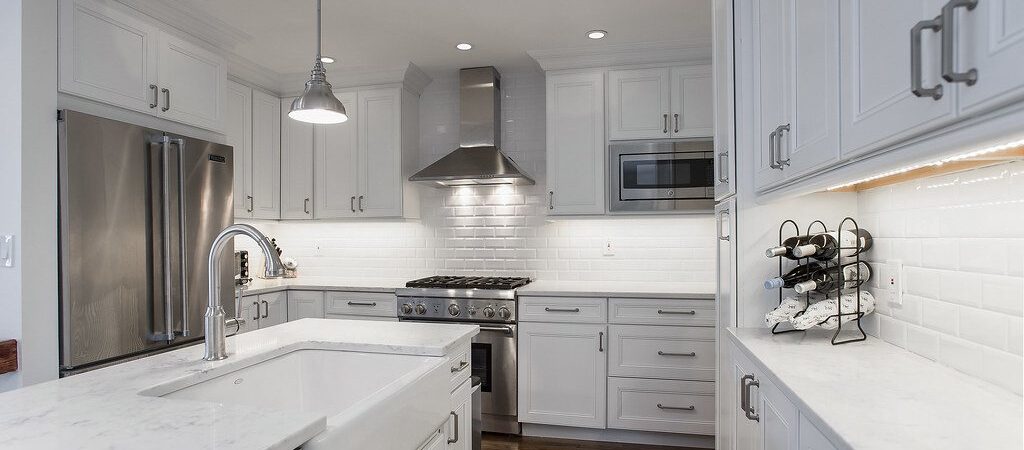
The kitchen is where a luxury home earns its keep. It is the room that hosts the morning rush, the dinner party that runs late, and the spilled wine nobody admits to. It is also the room that puts the most stress on a floor. Water, heat, dropped pans and constant foot traffic all conspire against a surface expected to look flawless for decades.
That tension is why waterproof flooring has become one of the most requested categories in luxury kitchens across Chicagoland. The good news: the days of choosing between durability and beauty are over.
What “Waterproof” Actually Means
The word gets used loosely, so it is worth drawing a clear line. Water-resistant means a floor can shrug off a spill if you wipe it up promptly. Waterproof means the core of the material itself will not swell, warp or delaminate when water sits on it.
The distinction matters most at the seams and edges, which is where water finds its way in. A truly waterproof kitchen floor depends on three things working together: a stable core, a tight locking system between planks, and proper detailing at cabinet toe-kicks, appliance bays and transitions. A premium product installed carelessly is not waterproof. Installation is half the promise.
The Strongest Options for a Luxury Kitchen
Luxury Vinyl Plank
For a kitchen that sees real life, luxury vinyl plank is often the most sensible answer. A rigid, fully waterproof core means standing water simply is not an emergency. Modern LVP has also come a long way visually, with deep embossing registered to the printed grain, wider planks, and matte finishes that read far closer to real wood than the vinyl of a decade ago. It is quiet underfoot, forgiving during long stretches of cooking, and comfortable over a Chicagoland basement or slab.
Engineered Hardwood
If you want genuine wood in the kitchen, engineered hardwood is the way to get it. A real hardwood wear layer over a dimensionally stable core resists the seasonal movement that plagues solid wood in our climate, where homes swing from humid August to bone-dry February with the furnace running.
Engineered wood is water-resistant rather than waterproof, and it will not survive a dishwasher line that runs all night. But in an open-concept plan, it lets one uninterrupted wood floor carry the whole level. That visual continuity is a defining feature of the best luxury homes we work in, and no substitute quite replicates it.
Porcelain, Stone and Laminate
Porcelain remains the most impervious surface you can put in a kitchen, and large-format tile can be genuinely beautiful. The trade-offs are hardness underfoot, a cold surface unless paired with radiant heat, and grout that needs maintenance. Premium laminate has improved considerably and resists scratches well, but for a high-splash kitchen we would still steer most clients toward a rigid-core waterproof product.
Designing the Kitchen Floor as Part of the Whole
The most common mistake we see in Chicago suburb renovations is treating the kitchen floor as an isolated decision. In open floor plans the kitchen is visible from nearly everywhere, and an abrupt change in species, tone or plank width draws the eye to the seam rather than the room.
- Run planks in one direction across the whole level wherever the layout allows. Continuity reads as luxury; a change of direction reads as a compromise.
- Choose finish before color. A matte or low-sheen surface hides crumbs, water spots and paw prints far better than gloss, and it is what most high-end kitchens specify now.
- Consider a defined border. A picture-frame border or an inset pattern at an island can give the kitchen ceremony without breaking material continuity.
- Mind the transitions. Where the kitchen meets tile in a mudroom or entry, a well-detailed transition protects the wood edge and keeps the line intentional.
You can see how these choices play out in finished homes in our project gallery, and explore the full range of materials on our flooring types page.
Notes for New Construction and Major Renovations
In new construction, waterproof performance starts long before the flooring arrives. Get the slab or subfloor moisture-tested, confirm the home has been through a full HVAC cycle to stabilize humidity, and coordinate the install with cabinetry so planks run correctly under the toe-kick and appliance bays.
One practical note on our process: ANA Flooring installs in cleared, ready spaces. We do not move furniture or remove old carpet, so sequencing that work ahead of our crews keeps the schedule clean and the finished result flawless.
So Which One Belongs in Your Kitchen?
If the kitchen is the hub of a busy household and water is a constant, choose a rigid-core waterproof plank and enjoy the peace of mind. If the kitchen anchors a formal open plan and the floor needs to read as real wood from every angle, choose engineered hardwood and manage water sensibly. If the room is a hard-working prep space, porcelain earns its place.
Costs vary widely with material grade, plank width and subfloor condition, so the honest answer on budget always comes from walking the space. That is what an on-site consultation is for.
Planning a flooring project in Chicagoland?
ANA Flooring brings 25+ years of craftsmanship to luxury homes, estates and new construction across the Chicago suburbs.